01
Deterministic 8-rule linter with revision diff
Turns messy, inconsistent interface control documents into a validated canonical spec — local-LLM extraction, deterministic linting, human approval, codec generation.
The situations this instrument was built for — and what it does about each one.
An ICD lives in a spreadsheet, and everyone who speaks the protocol re-implements it by hand — the bugs surface on the bench, late.
One checked intermediate representation, linted by eight deterministic rules, and a codec generated from the approved definition — so code and document cannot drift apart.
Extraction from a big document is tedious, but cloud AI is off the table on a closed program.
A local model over 127.0.0.1 proposes fields; every proposal is linted and approved field by field before it reaches the IR.
A new revision arrives and nobody is sure what actually changed.
Revision diff matches fields by path, not row order, and grades every change by how much it can hurt an existing implementation.
Deterministic 8-rule linter with revision diff
Local-LLM extraction that never touches the cloud
Approved-IR-only codec generation (C / Python)
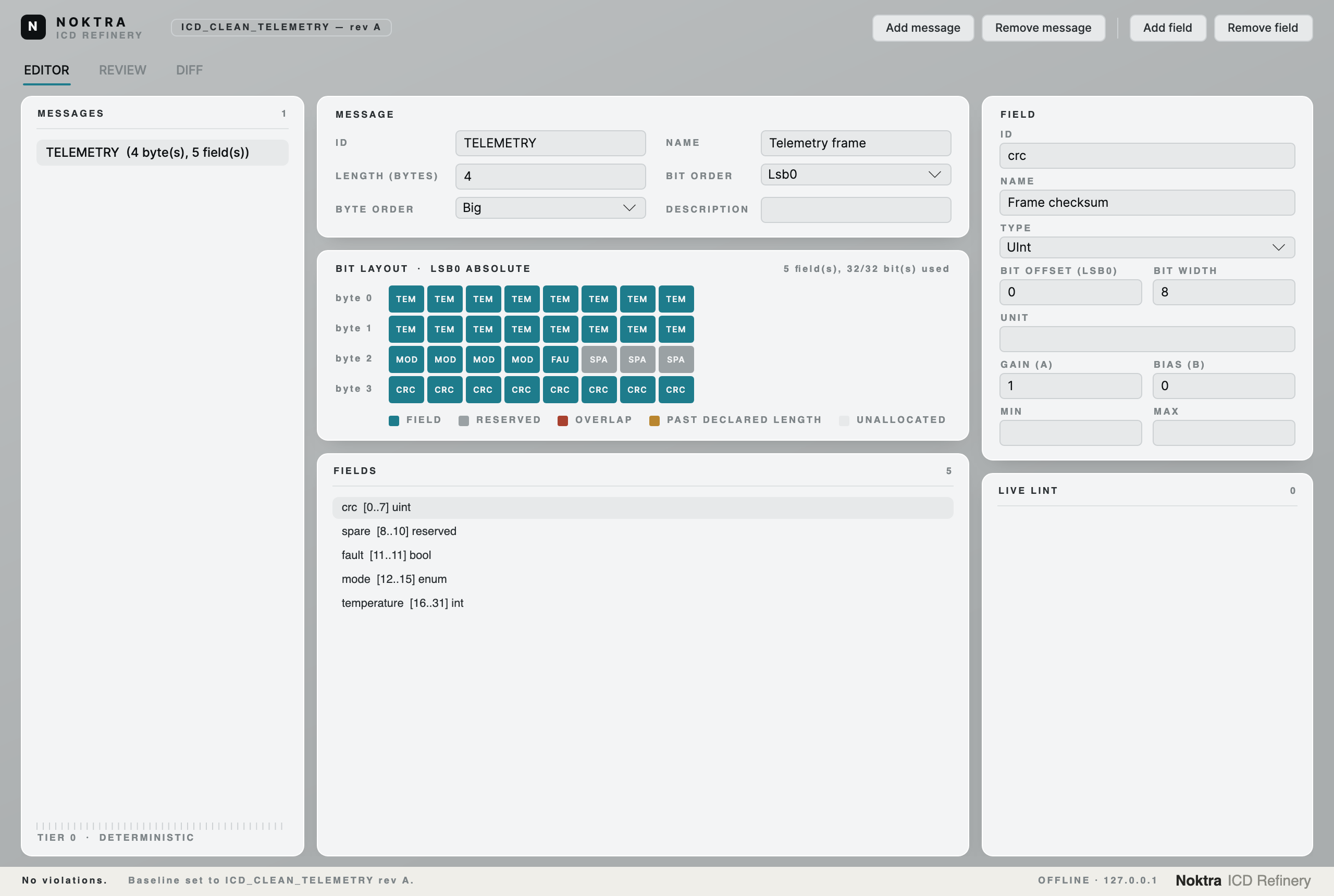
An ICD is usually a spreadsheet: one row per signal, a bit offset, a width, a unit, a scale factor. Everyone who has to speak the protocol re-implements it, and the bugs are found on the bench, late. ICD Refinery turns the document into one intermediate representation, checks it against eight rules that catch the mistakes that actually happen, shows what changed between revisions, and emits an encoder/decoder that matches the definition exactly.
The bit map and the lint list update on every keystroke. The map colours each bit by what owns it and marks collisions with a label as well as a colour; the lint list names every rule the layout breaks and where.
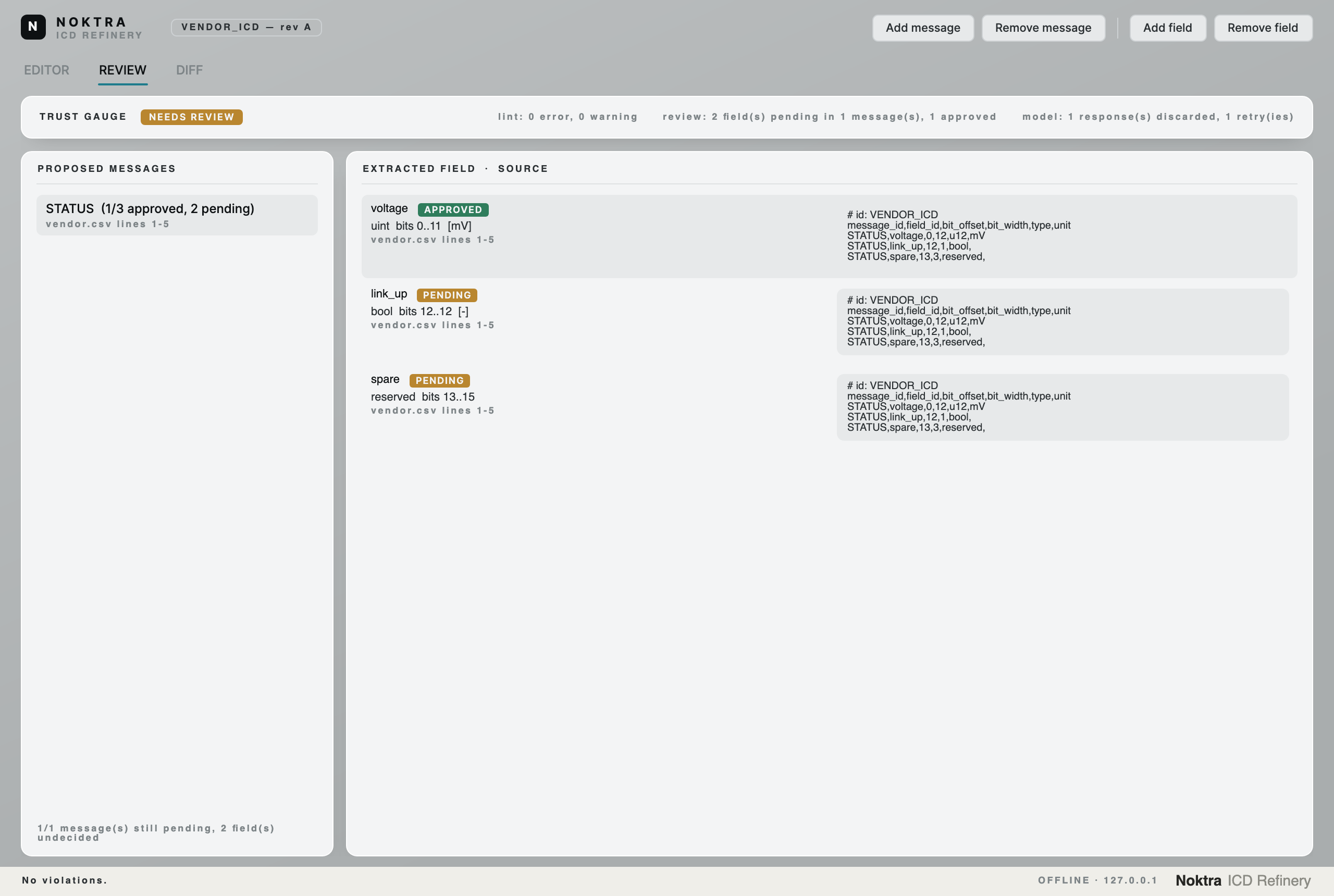
With a local Ollama installed, an extracted document arrives as a proposal: linted, shown beside the source lines it came from, and approved one field at a time. Nothing reaches the IR unapproved.
No installer, no package manager, no service account. Move the executable onto the air-gapped machine and open your work.
Yes. Like every NOKTRA instrument it is offline-first: no cloud services, no telemetry, and any AI runs locally on your own machine. It is built for air-gapped networks.
Windows 10/11 x64. It ships as a single executable — no runtime install.
Not yet — it is in development. It is listed with no promised date, until a build exists you can run.